You have been practising for a while. Maybe you want to teach. Maybe you just want to go deeper than a regular class allows.
Either way, you have probably come across online yoga teacher training and started wondering the same thing most serious practitioners wonder before spending money: is this the real thing, or a shortcut that studios and students will see through?
The short answer is yes, it is worth it, if you choose the right programme.
Online yoga teacher training is now widely accepted and, in many cases, just as thorough as in-person training. Thousands of certified teachers working in studios, gyms, and online platforms today trained entirely online. The format stopped being a barrier years ago.
But not every programme is equal, and some are genuinely not worth your time or money. This guide will give you a clear, practical answer so you can decide with confidence.
By the end you will know whether online training is globally recognised, what a good curriculum actually covers, how much you can realistically earn afterwards, and how to tell a strong programme from a weak one.
Who Is Online Yoga Teacher Training Best For?
Whether it is worth it depends almost entirely on why you are considering it. Most people fall into one of three situations.
1. You want to teach yoga professionally
If your goal is to teach in studios, gyms, corporate wellness settings, or online, you need a recognised certification, a structured curriculum, and enough practical teaching hours to actually know what you are doing. The format matters far less than whether the programme meets those standards.
2. You want to go deeper in your own practice
Not everyone who does a teacher training ends up teaching, and that is completely fine. Many people who have practised for years reach a point where a regular class no longer covers what they are looking for. Philosophy, breathwork, meditation, the subtle body. Online training often gives you access to teachers and traditions you simply cannot find locally.
3. You want to specialise
If you already have a foundation and want to go deep into Kundalini, Pranayama, Yin, Yoga Nidra, or therapeutic yoga, online is often the only realistic path. The teachers who genuinely know these traditions in depth are not evenly distributed across cities. Online training removes geography from the equation.
No matter which situation you are in, the training can be worth it. The mistake most people make is choosing a programme designed for a different type of student.
Is Online Yoga Teacher Training Officially Recognised?
This is the first question almost everyone asks, and the answer is yes, with one important detail you need to understand.
If the programme is registered with Yoga Alliance, you can complete it and apply for RYT-200 status, which stands for Registered Yoga Teacher. This is the standard credential accepted by studios and gyms in the US, UK, Canada, Australia, and most other countries. Whether the training was delivered online or in person does not affect that accreditation.
The detail that matters: Yoga Alliance registration does not automatically mean you will qualify for RYT-200 status. Some programmes earn continuing education credits only, not the full RYT credential. Before you enrol in anything, confirm directly with the school that completing their programme makes you eligible to register as an RYT-200. Ask them to show you their registered school page on the Yoga Alliance website.
In 2026, Yoga Alliance has also introduced a Social Credentialing System with verified graduate reviews and ratings. This makes it easier to assess a school’s actual quality beyond just checking whether it is listed.
What studios actually care about in practice is how well you teach. A strong teacher who trained online will consistently outperform a weak teacher who paid for an expensive in-person retreat. The credential opens the door. Your teaching keeps it open.
What You Learn in Online Yoga Teacher Training (Complete Curriculum)
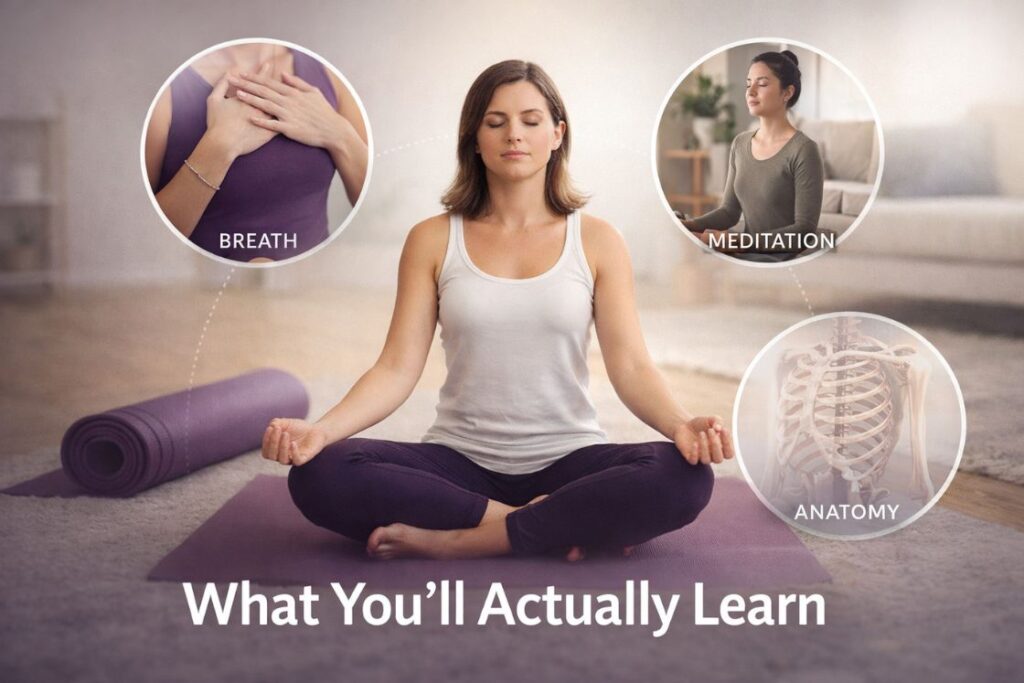
A good programme goes far beyond poses. Here is what a solid 200-hour curriculum covers and why each part matters.
Hatha Yoga and asana foundations
This is where everything starts.
You don’t just learn how to do postures you understand why they’re done a certain way. You begin to see how the body moves, how joints are protected, and how sequences are built safely.
You also learn how to adapt postures for different bodies, injuries, and experience levels – which is what turns practice into teaching.
Pranayama
For many students, this is where yoga really begins to deepen.
Most people have only experienced basic breathing in class- often without fully understanding it. A proper training opens this up.
You explore techniques like Nadi Shodhana, Kapalabhati, and Bhramari – but more importantly, you learn when to use them, how they affect the nervous system, and how to guide others safely.
This is often the point where people realise yoga is much more than physical movement.
Kundalini yoga
Kundalini is not just a style it’s a complete system.
It combines movement, breath, mantra, and meditation in structured sequences called kriyas. You also work with bandhas (energy locks), sound, and the concept of the subtle body.
It feels very different from a typical Hatha or Vinyasa class more internal, more focused, and often more intense in its effect.
If you’re considering going deeper into this path, a full-length Kundalini teacher training provides a much more complete and structured experience. 👉 Learn More
Yoga mudra
Mudras are subtle, but powerful.
Rather than learning them as isolated hand gestures, you understand how they fit into practice within meditation, pranayama, or Kundalini work.
You begin to see how small shifts in the body can influence energy, attention, and internal state.
Yoga nidra (Yogic Sleep)
Yoga Nidra introduces a completely different kind of practice.
It’s a guided state between waking and sleep where the body rests deeply while awareness remains. This is what makes it so effective for stress, recovery, and mental clarity.
In training, you learn how to guide this process not just follow it including how to structure sessions and work with intention (sankalpa).
Yin yoga
Yin slows everything down.
Instead of movement, the focus is on stillness- holding poses for several minutes and working deeper into connective tissue.
It teaches patience, awareness, and a different relationship with discomfort. For many teachers, this becomes an essential complement to more active styles.
Meditation teacher training
You learn to guide different types of meditation, from breath awareness to mantra to visualisation, and how to work with students who find it difficult to sit still or stay focused. This is also where many people find the most personal value in the training.
Teaching methodology and practicum
Knowing yoga and teaching yoga are genuinely different skills. This is where they come together. Cueing clearly, structuring a class with intention, reading a room, giving useful feedback. In online training this typically involves recorded practice teaching, peer reviews, and direct feedback from the lead teachers. This component is non-negotiable for anyone who plans to teach professionally.
Yoga philosophy
The Yoga Sutras of Patanjali, the Bhagavad Gita, the Eight Limbs, the concept of the gunas. Good training does not present these as abstract theory you memorise for a test. You learn how these ideas land in practice, in how you live and how you teach. This is what gives yoga depth beyond the physical.
Anatomy and physiology for yoga
Spine, joints, muscles, nervous system. Not so technical that it becomes a biology course, but thorough enough that you understand what is happening in the body during practice and can teach safely. You need this foundation when a student comes to class with a lower back issue, hypermobility, or a recent injury.
Teaching methodology and practicum
Knowing yoga and teaching yoga are genuinely different skills. This is where they come together. Cueing clearly, structuring a class with intention, reading a room, giving useful feedback. In online training this typically involves recorded practice teaching, peer reviews, and direct feedback from the lead teachers. This component is non-negotiable for anyone who plans to teach professionally.
Online vs In-Person Yoga Teacher Training (2026 Comparison)
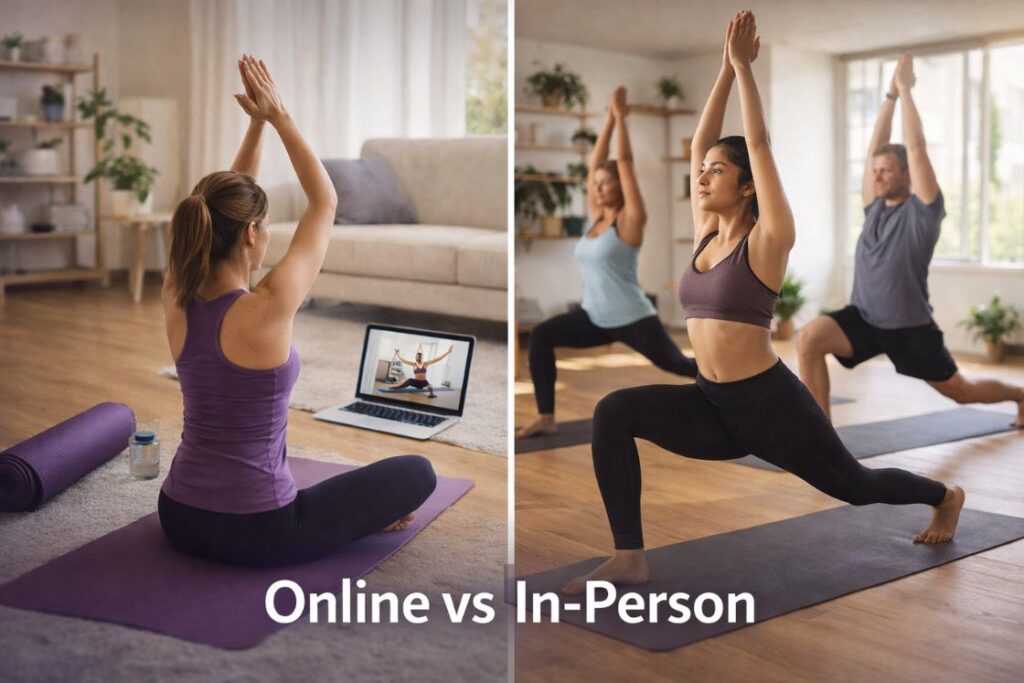
The gap between online and in-person training has closed significantly over the past few years. Here is a realistic comparison.
| Factor | Online YTT | In-Person YTT |
|---|---|---|
| Typical Cost | $400 to $1,800 | $2,500 to $8,000+ (plus travel) |
| Schedule | Self-paced or live cohort, flexible across time zones | Fixed dates and fixed location |
| Specialisation Options | Wide range: Kundalini, Yin, Nidra, Pranayama, Therapeutic | Usually general 200-hour Hatha format |
| Accreditation | Yoga Alliance registered programmes available | Yoga Alliance registered programmes available |
| Immersion Quality | Builds depth over time with self-discipline | Retreat-style learning for faster initial progress |
| Physical Adjustments | Guided through video feedback and self-practice | Direct, in-person adjustments from teachers |
| Community | Online groups, live sessions, ongoing support | Strong bonds during training, may reduce after course |
| Best For | Working professionals, parents, remote learners | Those seeking full immersion and able to travel |
The practical reality is simple: most studios do not ask whether your training was online or in-person. They ask you to teach a trial class.
5 Reasons Online Yoga Teacher Training Is Worth It
1. The cost difference is real
Online training typically costs between $400 and $1,800. Once you factor in flights, accommodation, food, and time away from work or family, an in-person residential programme can easily exceed $10,000. That gap either makes training accessible for the first time or frees up budget for further certifications and specialisations.
2. You can access teachers you would not find locally
Most local studios offer general Hatha or Vinyasa training. Specialised knowledge in Kundalini, Pranayama, or Yoga Nidra is concentrated among a relatively small number of experienced teachers worldwide. Online training puts them within reach regardless of where you live.
3. The pace lets you actually absorb the material
In a one-month residential retreat you process a 200-hour curriculum in compressed bursts, often without much time to integrate what you are learning. With online training you can practise between sessions, revisit recordings, and let concepts settle before moving on. For many people this leads to a more thorough and lasting understanding.
4. You train for the way teaching actually happens now
A significant portion of yoga teaching in 2026 happens through Zoom, recorded programmes, and online membership platforms. Training in an online environment means you are already comfortable with that format before you ever take a student. This is not a minor advantage.
5. It is fully recognised where it counts
Provided the programme is Yoga Alliance registered, your certification carries the same weight as in-person training when applying to studios, gyms, and corporate clients. The credential is recognised internationally.
When Online Yoga Teacher Training Is NOT Worth It
If you are completely new to yoga, teacher training is not the right starting point. Most reputable programmes expect at least one to two years of regular practice. Training builds on a foundation you already have. If you enrol too early you will spend the programme catching up on basics instead of going deeper.
If you genuinely struggle with self-discipline, the flexibility of online training works against you. There is no retreat environment pushing you to show up every morning. Without internal structure it is easy to fall behind, and equally easy to coast through the material without actually engaging with it. Some people do better in a setting where everything is scheduled for them.
If hands-on physical adjustment is central to what you want to develop, online training has real limits here. You can learn cueing, sequencing, and class structure very effectively online. Tactile feedback and the in-person experience of adjusting another body cannot be fully replicated through a screen. If this is a priority, consider combining online learning with in-person workshops.
If the programme is not properly accredited, the certificate carries no real value. There are programmes that look professional online but do not meet recognised standards. Always verify the school’s registration on the Yoga Alliance website before paying anything.
How Much Does Online Yoga Teacher Training Cost?
| Programme Type | Typical Price Range |
|---|---|
| 200-hour general (Hatha or Vinyasa) | $400 to $1,200 |
| 200-hour specialised (Kundalini, Yin, Therapeutic) | $500 to $1,800 |
| 300-hour advanced YTT | $1,000 to $2,500 |
| Short certifications (Pranayama, Yoga Nidra, Meditation, Yin) | $150 to $600 |
| In-person residential (for comparison) | $2,500 to $8,000+ (excluding travel) |
A very low price sometimes signals limited depth or missing accreditation. A higher price does not guarantee quality. The question is whether the programme offers genuine value at that price, not whether it is the cheapest or the most expensive option available.
What Can You Realistically Earn as a Yoga Teacher?
Most articles talk about career outcomes without giving actual numbers. Here is what the current market looks like.
| Teaching Format | Typical Rate | Notes |
|---|---|---|
| Studio class (new teacher) | $25 to $45 per class | Substitute roles and small group classes to start |
| Studio class (established teacher) | $50 to $100 per class | Regular schedule with consistent students |
| Private sessions | $70 to $150 per hour | One-to-one sessions, in person or online |
| Corporate wellness | $100 to $250 per session | Office visits and workplace wellbeing programmes |
| Online teaching / memberships | Varies significantly | Subscription-based income, takes time to grow |
Most new teachers start with a combination of studio substitutions and private clients while building toward a steadier schedule. Full-time income from teaching yoga is achievable but it takes time, typically one to three years of consistent work. Treating it like a business from the start makes the biggest difference to how quickly that happens.
Building a specific niche, Kundalini for professionals, Yoga Nidra for sleep, Pranayama for athletes, tends to accelerate both recognition and income compared to teaching general yoga to a general audience.
What Graduates Say
Priya M., London: “I was sceptical going in. I had done an in-person training years before and assumed online would feel thin by comparison. It did not. The Kundalini curriculum especially went into depths I had not encountered before. I am now teaching two corporate wellness sessions a week alongside my regular studio classes.”
James T., Saskatchewan, Canada: “I live in a small city where there is basically no access to specialist yoga training. Without online options this simply would not have been possible. The live sessions with the teachers made it feel genuinely connected rather than just watching videos on my own.”
Shreya K., Bangalore: “The anatomy content alone was worth the cost. I had been teaching for a year after a different certification and realised I was guessing about safe alignment for students with injuries. This filled that gap properly and gave me real confidence.”
How the Main Online YTT Programmes Compare in 2026
There are dozens of options. These are among the most established and consistently reviewed programmes:
| School | Hours | Style Focus | Yoga Alliance | Price Range | Format |
|---|---|---|---|---|---|
| Fitsri Yoga | 200-hr | Kundalini, Pranayama, Nidra | Registered | $499 to $700 | Live sessions + self-paced |
| YogaRenew | 200-hr | Hatha, Vinyasa | Registered | $347 to $597 | Fully self-paced |
| Yoga International | 200-hr | Hatha, Yin, Therapeutic | Registered | $450 to $800 | Self-paced + live Q&A |
| Yoga Education Institute | 200-hr | Hatha, Prenatal, Kids Yoga | Registered | $500 to $900 | Live cohort, small groups |
| DoYogaWithMe | 200-hr | Multi-style | Registered | $400 to $700 | Self-paced + mentorship |
Always verify Yoga Alliance registration independently before enrolling. Pricing and programme formats change, so check directly with each school for current details.
How to Choose the Right Online Yoga Teacher Training Program
Start with accreditation, done properly
Go to the Yoga Alliance website and search for the school by name. Confirm it is listed as a Registered Yoga School. Then confirm that completing the programme makes you eligible for RYT-200 status specifically, not just continuing education credits. These are different things, and the distinction matters.
Look at how hours are broken down
A 200-hour training should show you exactly how those hours are divided across asana, pranayama, philosophy, anatomy, and teaching methodology. Yoga Alliance publishes its minimum hour requirements publicly. If a programme cannot provide a clear breakdown, that is a sign something is off.
Research the teachers outside the school’s own website
Look up the lead teachers independently. What is their background? Where did they train? Have they written, taught publicly, or built a body of work you can find and assess? For specialised traditions like Kundalini or Pranayama, lineage and depth of experience matter more than a polished course page.
Find reviews that are not on the school’s own site
The Yoga Alliance school page has verified graduate reviews. Google reviews and Reddit (r/yoga in particular) give you unfiltered opinions. Look for patterns across multiple reviews rather than individual outliers. The useful signal is whether graduates are actually teaching afterwards and whether they describe real learning or just a pleasant experience.
Understand what live interaction is included
A fully pre-recorded course with no live sessions or personal feedback is lower quality than one that includes regular contact with the teachers. This matters especially for developing as a teacher. Feedback on your cueing, your sequencing, and how you hold a class is not something you can get from a video alone.
Check for inclusive practice and values
Good programmes in 2026 teach not just how to guide postures but how to create accessible, welcoming classes for students with different bodies, backgrounds, and abilities. This is part of being a well-rounded teacher, not an optional extra.
How Long Does Online Yoga Teacher Training Take?
| Format | Typical Duration | Weekly Time Required |
|---|---|---|
| Self-paced (200 hours) | 3 to 12 months | 4 to 10 hours per week |
| Live cohort (200 hours) | 8 to 16 weeks | 10 to 15 hours per week |
| Intensive (200 hours) | 3 to 4 weeks | Full-time commitment |
| Short certification (50 hours) | 2 to 6 weeks | 4 to 8 hours per week |
Self-paced formats offer the most flexibility and require the most personal discipline. Setting a fixed weekly schedule and treating it as a real commitment rather than something you will get to eventually makes a significant difference to completion rates and what you retain from the training.
Specialisations Worth Looking at in 2026
If you are deciding between a general 200-hour training and a specialised path, or planning what to do after your initial certification, these areas have genuine demand right now.
Pranayama teacher training
Breathwork has become a central part of the wellness industry beyond yoga. A dedicated Pranayama training opens doors in stress management, corporate wellbeing, and therapeutic settings that a general yoga certification does not reach.
Kundalini Yoga teacher training
A structured, distinct system combining movement, breath, mantra, and meditation. Students drawn to deeper internal work rather than physical performance find Kundalini particularly compelling. Worth learning through a proper focused training rather than as a brief module within a general course.
Yin Yoga teacher training
Slow, quiet, and highly complementary to more active styles. Popular with students who want to balance high-intensity training. One of the more straightforward specialisations to add to an existing teaching practice.
Yoga Nidra teacher training
Increasingly used in healthcare, stress management, sleep therapy, and recovery settings. A practical and in-demand specialisation if you are interested in therapeutic work or building online content around specific outcomes.
Therapeutic yoga teacher training
Working with people dealing with pain, injury, or chronic conditions. Often leads to more personalised, meaningful teaching relationships and opportunities well outside traditional studio settings.
Meditation teacher training
Meditation is now embedded across healthcare, education, and corporate environments. A dedicated training helps you guide different styles confidently, especially with students who find it difficult to sit or to stay focused. It works well both as a standalone offering and as a complement to yoga teaching.
What You Can Do After Qualifying
Most certified teachers pursue a mix of these in the early years:
Teaching studio or gym classes. Starting with substitute slots and building toward a regular class schedule. Trial classes are standard, so your teaching ability matters more than where you trained.
Working with private clients. One-to-one sessions, in person or online. Usually better paid per hour than studio work and a good way to build confidence and teaching range in the early stages.
Building an online teaching business. Live classes via Zoom, recorded programmes, or a subscription platform. Takes time to build an audience but removes geography as a constraint entirely.
Corporate wellness. Office yoga, breathwork sessions, and wellbeing programmes. Typically the best-paid format per session and more accessible than most new teachers realise.
Therapeutic or specialist work. With further training, working in injury recovery, stress management, or with specific populations. More specialised, often more personally rewarding.
Deepening your own practice without teaching professionally. A completely valid outcome. The understanding you develop about your own practice during a good training has real and lasting value in itself.
Continuing to advanced training. Your 200-hour certification is the starting point, not the destination. A 300-hour advanced training leads to RYT-500 status and opens more doors for both teaching and further specialisation.
FAQs
Yes, provided the programme is Yoga Alliance registered. The majority of studios and gyms in the US, UK, Australia, and Canada accept recognised certifications regardless of whether the training was completed online or in person. What they actually assess is whether you can teach. A trial class is standard for any new hire.
Yes, provided the programme is registered with Yoga Alliance as an RYS and the training hours meet the 200-hour standard requirements across all required subject areas. Confirm this before enrolling by looking up the school on the Yoga Alliance website. Not every accredited programme qualifies you for RYT-200 specifically. Some count only as continuing education credits, which is a different category.
Most reputable programmes require at least one to two years of consistent practice. Teacher training is not designed to introduce you to yoga. It builds on a foundation you already have. If you are relatively new, spend more time as a student first. You will get significantly more from the training when you are ready for it.
A 200-hour training is the entry-level professional certification, leading to RYT-200 status. A 300-hour training is advanced study completed on top of your 200 hours, leading to RYT-500 status. You do the 200 hours first. The 300-hour is for teachers who want to go deeper, whether into a specific tradition, advanced teaching methodology, or therapeutic applications.
Most new teachers start earning within a few months of qualifying, usually through a mix of studio substitution slots, small group classes, and private clients. Building a sustainable full-time income typically takes one to three years. How quickly that happens depends heavily on consistency, relationship building, and developing a clear niche. Online teaching can accelerate things if you build an audience, but audience-building itself takes time and regular effort.
Completely. Many people complete a 200-hour training with no intention of ever teaching professionally. The depth of understanding you develop around your practice, philosophy, breathwork, and meditation is genuinely valuable on its own terms. You do not need to justify the investment with a teaching career.
Final Verdict: Is Online YTTC Worth It in 2026?
Online yoga teacher training is worth it when the programme is properly accredited, the teachers have genuine depth in what they are teaching, and you approach it with the same commitment you would bring to any serious training.
It is not a shortcut. The best online programmes cover the same ground as residential training, often going deeper in specialised areas, at a fraction of the total cost. The format stopped being a quality barrier years ago.
What it does require is that you show up consistently. Without the structure of a retreat environment around you, the discipline to engage fully has to come from you. People who do well with online training tend to set clear weekly schedules, engage with live sessions rather than only recordings, and take the teaching practice component seriously rather than rushing through it to get the certificate.
If you have been practising for a couple of years and are ready to go deeper, whether as a teacher or simply as a practitioner, a well-chosen online programme is a legitimate and practical path.
The question is not whether online training can be real. It is whether the specific programme you are considering actually delivers.
Take the Next Step
If you feel ready to explore this further, you don’t need to jump straight into a full certification.
You can start with shorter, focused experiences like:
- Pranayama (breathwork) workshops
- Yoga Nidra sessions for deep relaxation
- Mudra practices for subtle energy work
And if you’re looking for a more complete path, a structured 200-hour training such as Kundalini yoga can give you a deeper and more integrated understanding of the practice.
The key is to begin with what feels right for you.