
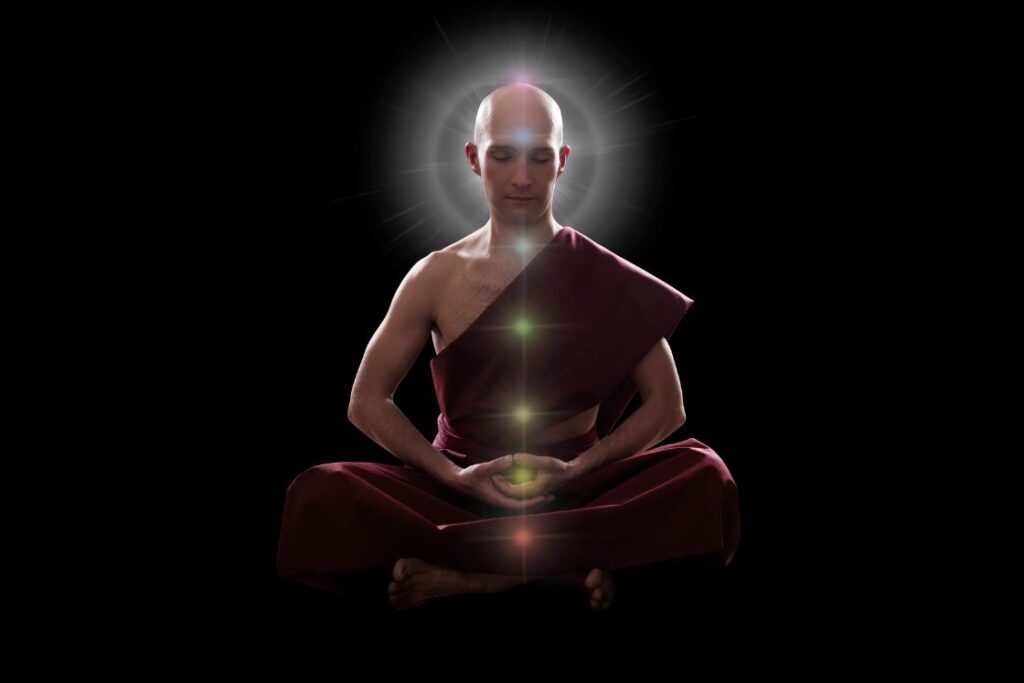
Tantra Yoga is a holistic spiritual practice that uses breath, movement, meditation, and energy awareness to expand consciousness and integrate body and mind.
Tantra Yoga is an ancient yogic path that integrates body, breath, mind, and energy into a unified practice aimed at expanding awareness and liberation.
Tantra Yoga is one of the oldest systems of spiritual growth, yet also one of the most misunderstood. Today, many people associate Tantra with rituals or sensual practices, but in its authentic form, it is a path of awareness that helps integrate body, mind, and spirit into a unified experience.
In Sanskrit, the word Tantra means “to expand” and “to liberate.” It describes a way of life that widens perception and frees us from limitation. Tantra Yoga brings this wisdom into practice through the body, breath, sound, and energy awakening the deeper potential within.
While some spiritual traditions emphasise withdrawal from the world, Tantra Yoga teaches that life itself is the practice. Every experience joy, challenge, movement, or stillness becomes an opportunity for self-realisation and deeper awareness.
This article explores the meaning of Tantra Yoga, its historical roots, core philosophy, and practical methods. You will also discover how Tantra Yoga supports personal growth and inner balance in modern life.
What is tantra? meaning and true definition

When people hear the word Tantra, they often associate it with mystery or secrecy. However, in its original context, Tantra is a vast spiritual philosophy that explores consciousness, energy, and the nature of reality. It teaches that spiritual growth comes not from rejecting life, but from understanding and integrating every experience.
The word Tantra comes from two Sanskrit roots:
- Tan, meaning “to expand”
- Tra, meaning “to free or liberate”
Together, they describe a path of expansion and liberation a way of widening awareness and recognising the interconnected nature of existence.
Tantra does not ask you to deny the body or emotions. Instead, it views them as tools for awakening. Every experience, whether pleasant or challenging, becomes part of personal transformation. This inclusive perspective is what makes Tantra unique among spiritual traditions.
At its essence, Tantra is about connection. It brings together body, breath, mind, and energy into one integrated system. Through this harmony, practitioners learn to live with greater balance, awareness, and a sense of the sacred in everyday life.
Also Read: Concept of Creation in Tantra
What is tantra yoga?
Tantra Yoga is the practical application of Tantric philosophy in daily life. It transforms the understanding of consciousness and energy into direct experience through the body, breath, and awareness.
The word Yoga means “union.” When combined with Tantra, it refers to a path of awakening achieved through expansion and integration. Tantra Yoga views the body and mind as instruments of awareness, where everyday activities breathing, working, resting, and relating become part of spiritual growth.
Rather than separating spirituality from life, Tantra Yoga teaches that awareness can be cultivated in every moment. This makes it both a contemplative and experiential path.
Core practices of tantra yoga
Tantra Yoga works through a combination of practices that support balance across physical, mental, and energetic levels.
- Asanas (Postures): Strengthen the body and open energy channels.
- Pranayama (Breath Control): Balance life force and purify the mind.
- Mantra (Sacred Sound): Create vibration that aligns the mind with higher energy.
- Mudras and Bandhas: Direct energy through specific channels.
- Chakra Meditation: Cleanse and awaken inner energy.
- Silence and Reflection: Bring awareness to the stillness within.
Together, these practices create an integrated system that supports self-awareness, emotional balance, and spiritual growth.
Core philosophy of tantra yoga (shiva and shakti)
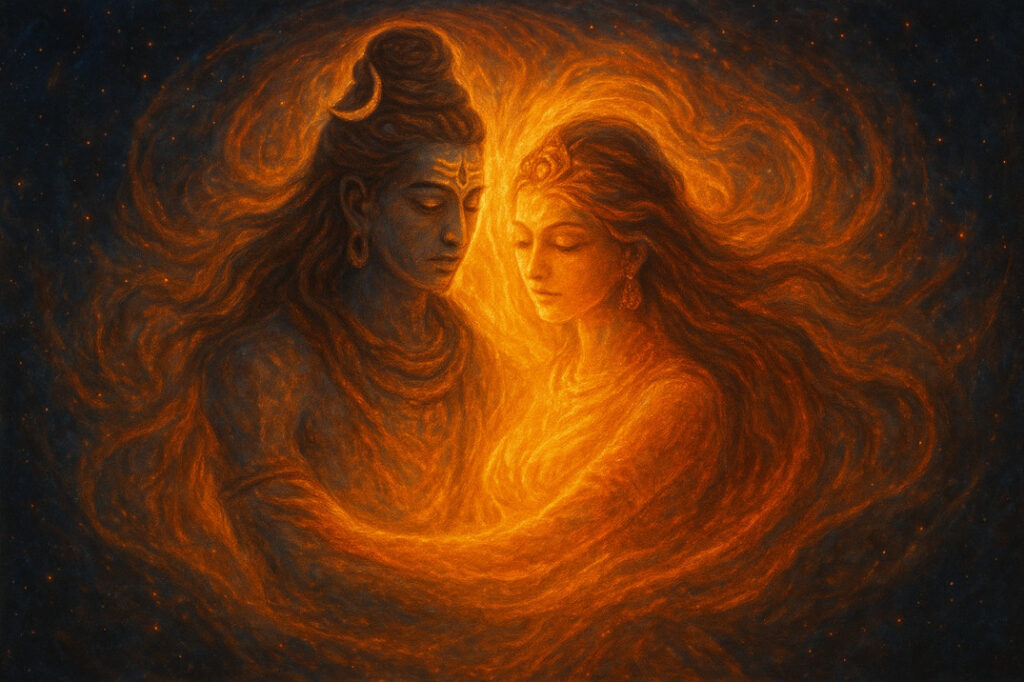
At the heart of Tantra Yoga lies a simple yet profound insight: all existence arises from one unified reality expressed as consciousness and energy. From the vastness of the cosmos to the thoughts within the mind, everything emerges from this same source. Recognising this connection is seen as a step toward inner freedom and expanded awareness.
Tantric philosophy describes this universal process as the interplay of two fundamental forces Shiva and Shakti.
Shiva represents pure consciousness: still, silent, and unchanging.
Shakti represents dynamic energy: the creative power that manifests as movement, life, and transformation.
These forces are inseparable, like a flame and its heat. Tantra Yoga teaches that when awareness and energy come into harmony within the individual, a sense of balance and wholeness naturally arises.
To explain the unfolding of consciousness, Tantric traditions describe 36 tattvas, or principles of existence. These range from the five physical elements earth, water, fire, air, and space — to subtler layers of mind and awareness. The path of Tantra involves recognising these layers within oneself, moving from outer experience toward deeper awareness.
Tantra provides practical tools to experience this philosophy directly
- Mantra — sacred sound that awakens energy and stills the mind.
- Yantra — sacred geometry that helps focus awareness.
- Mandala — symbolic diagrams that reflect cosmic unity.
Through these practices, Tantra becomes a lived experience rather than a concept. It invites practitioners to recognise the unity of consciousness and energy within themselves and in the world around them.
Also Read: Tantra: The Ancient Indian Path of Liberation and Consciousness
Tantra and the classical indian philosophies
To understand Tantra more deeply, it helps to see where it fits among India’s ancient philosophies. The six classical schools, known as the Shad-Darshanas, are Sankhya, Yoga, Nyaya, Vaisheshika, Mimamsa, and Vedanta. All accept the Vedas as their spiritual authority.
Alongside them were non-Vedic systems like Buddhism, Jainism, and Charvaka, which questioned or rejected the authority of the Vedas. These are known as Nastika philosophies.
Tantra stands apart from both groups. It neither depends on nor rejects the Vedas. Instead, it follows a path of direct experience- truth verified through practice rather than belief. For Tantric seekers, every experience is a teacher and every part of life is sacred.
While other traditions often teach withdrawal or renunciation, Tantra embraces life fully. It sees the world not as an illusion but as a divine expression. Liberation, therefore, is not about escaping life but about seeing the sacred within it.
This unique view shaped later yogic systems. Classical Yoga often seeks to control the body to reach the mind, while Tantra uses the body as a bridge to the spirit. It honours the same energy that moves the universe as the energy that lives within us.
The historical roots of tantra
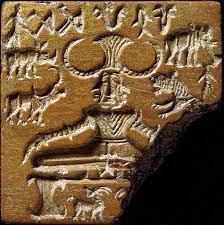
The story of Tantra reaches back thousands of years, even before the Vedic period. Though many original texts were lost, the earliest evidence of Tantric ideas appears in the Indus Valley Civilization around 3000 BCE.
Archaeologists discovered a small clay seal in Mohenjo-Daro showing a figure seated in a yogic posture surrounded by animals. This figure, known as Pashupati, a form of Lord Shiva meaning “Lord of the Animals,” is seated with crossed legs and heels pressing the perineum- a posture used in Tantra to awaken Kundalini, the energy at the base of the spine.
This discovery shows that yogic and Tantric practices existed thousands of years ago. It also highlights Shaivism, the worship of Shiva as pure consciousness, and Shaktism, the worship of the Divine Mother, Shakti, as the creative energy of the universe. Together, Shiva and Shakti form the foundation of Tantric thought.
As centuries passed, the culture of northern Vedic people merged with southern Dravidian spirituality, creating a rich and diverse Tantric tradition. The sacred texts from this era were called Agamas, meaning “what has come down to us.” These texts described methods of meditation, energy awakening, and spiritual discipline that shaped the Tantra we know today.
From these ancient roots, Tantra spread across India and later influenced many yogic paths, including Hatha Yoga and Kundalini Yoga. It continues to live as a science of consciousness – practical, experiential, and deeply transformative.
Classification of the tantras (92 foundational texts)
As Tantra evolved, its teachings were preserved in a large body of scriptures collectively called the Tantras or Agamas. Traditional Shaiva scholars classify the Tantric scriptures into 92 main texts, grouped according to their philosophical view of reality.
1. 64 Abheda tantras (Non-dual / Bhairava Tantras)
These texts teach a non-dual understanding of reality—where Shiva and Shakti are one, and the world is a direct expression of divine consciousness.
They form the foundation of Kashmir Shaivism and many Shakta traditions.
2. 18 Bhedābheda tantras (Mixed / Rudra Tantras)
These texts blend both dualistic and non-dual ideas.
They describe a path where the practitioner recognises unity through devotion, discipline, and inner worship.
3. 10 Bheda tantras (Dualistic / Śiva Tantras)
These scriptures describe the world as separate from the divine, emphasising ritual, worship, and devotion to Shiva as the Supreme Being.
This three-fold division helps us understand the wide philosophical range within Tantra—from purely non-dual teachings to devotional dualistic traditions.
Modern scholars such as Alexis Sanderson note that the 64 Abheda Tantras form the heart of monistic Shaiva-Shakta traditions, while the mixed and dualistic groups shaped temple ritual systems and devotional Tantric practices across India.
Why this classification matters
Understanding the 92 Tantras shows how diverse the Tantric tradition really is.
While many people think of Tantra as one single system, it actually includes:
- non-dual philosophy,
- devotional worship,
- subtle-body energy practices,
- and ritual traditions.
This diversity is what allowed Tantra to influence later paths such as Hatha Yoga, Kundalini Yoga, and Laya Yoga.
Join Our 40-Day Live Tantra-Based Kundalini Yoga Course
Types of tantra yoga
Tantra Yoga includes several paths, each guiding the practitioner in a unique way. The three main types are Kaula, Mishra, and Samaya Tantra.
1. Kaula Tantra
Kaula means “family” or “group.” It teaches that all aspects of life — the body, relationships, and daily activities- are part of the divine. Kaula Tantra transforms ordinary experiences into spiritual realisation.
It includes:
- Vama Marga (left-hand path): advanced and unconventional rituals to break mental barriers.
- Dakshina Marga (right-hand path): focused on purity, devotion, and discipline.
2. Mishra Tantra
Mishra means “mixed.” This path blends external rituals with internal meditation, balancing the physical and the spiritual. It offers a middle way — practical, balanced, and suitable for most seekers.
3. Samaya Tantra
Samaya means “to be one with her.” This is the highest and purest path, focused entirely on inner experience and devotion to the Divine Mother (Shakti). Here, worship happens through meditation, awareness, and love, leading to unity with universal consciousness.
How tantra yoga transforms you
Tantra Yoga is more than a set of practices- it is a journey that changes how you live, think, and feel. With steady practice, it brings balance to the body, peace to the mind, and lightness to the heart. These transformations touch every part of life, helping you live with calm awareness and confidence.
Benefits of tantra yoga include:
- Inner Strength and Fearlessness: Tantra Yoga teaches you to face life as it is, without fear or avoidance. As you gain control over your body and mind, you begin to feel strong, steady, and unshaken by challenges.
- Acceptance of Truth and Reality: This practice helps you see things clearly and accept them with wisdom. You stop running from difficulties and start seeing them as lessons that help you grow.
- Emotional Balance and Compassion: By observing thoughts and emotions without reacting, you learn to stay centred. This awareness softens the heart, allowing compassion and understanding to grow naturally.
- Clarity of Mind and Focus: The combination of breathwork, mantra, and meditation clears mental clutter. Your thoughts become sharper, concentration improves, and decision-making feels effortless.
- Better Physical Health and Energy: Asanas and pranayama strengthen the body, improve flexibility, and boost circulation. Regular practice increases stamina and fills you with steady, natural energy throughout the day.
- Deeper Spiritual Awareness: Tantra awakens the inner energy that connects you to something greater than yourself. It helps you feel the presence of the divine in ordinary moments of life.
- Joy, Peace, and Harmony in Daily Life: With balanced energy and a calm mind, you begin to live with ease and gratitude. Everyday activities become peaceful and meaningful, filled with quiet joy.
Unlike paths that aim to escape the world, Tantra Yoga brings liberation within it- helping you live with awareness and grace in every moment.g.
The goal: liberation from maya
The ultimate aim of Tantra Yoga is freedom from Maya, the illusion of separation. Maya makes us forget our true nature as pure consciousness. Tantra lifts this veil by teaching us to see the divine in all things.
True liberation does not mean escaping daily life but living it with awareness. When you see beyond opposites – good and bad, joy and sorrow — peace arises naturally. Through regular practice of meditation, mantra, and pranayama, the mind clears, the heart softens, and awareness expands into unity with all life.
Conclusion
Tantra Yoga is more than philosophy it is a way of living with awareness. It teaches that divinity is not far away but present in every breath, sound, and feeling.
In Tantra, Shiva is stillness and Shakti is movement. Together they form the rhythm of life- the dance of consciousness and energy that flows through all creation. When we live in awareness of this dance, we see that we are never separate from the universe.
To live Tantra is to live consciously to see beauty, wisdom, and sacredness in all things. When energy and awareness move together in balance, life itself becomes a meditation, filled with peace, unity, and joy.
Tantra Yoga FAQs
Tantra Yoga is a holistic practice that combines movement, breathwork, meditation, and energy awareness to deepen connection between body and mind. Its goal is personal transformation and expanded awareness, not physical performance. Most modern classes focus on mindfulness, relaxation, and self-exploration.
Traditional styles like Hatha or Vinyasa emphasise physical postures, while Tantra Yoga focuses more on breath, meditation, and subtle energy awareness. Movement is used as a tool for inner exploration rather than fitness.
Tantra Yoga is a broader spiritual system that works with the body, breath, mind, and energy to understand the nature of consciousness. Kundalini Yoga is one path within Tantra that focuses specifically on awakening the dormant energy at the base of the spine and guiding it through the chakras.
In traditions such as the Bihar School of Yoga, Kundalini awakening is seen as a higher outcome of Tantric practice, but Tantra itself includes many other methods, including mantra, kriya, yantra, ritual, and meditation.
Yes. In the Satyananda tradition, beginners often start with simple practices that are already rooted in Tantra, such as Yoga Nidra, basic pranayama, mantra chanting, and trataka.
You don’t need advanced rituals to begin. The Bihar School of Yoga recommends starting with body awareness, breath regulation, and mantra, which are considered safe and foundational entry points into Tantra Yoga.
In Tantra, the universe is seen as the union of two fundamental forces: Shiva and Shakti. Shiva represents pure consciousness still, silent, and unchanging while Shakti is the dynamic energy that creates and moves all life.
Tantric practice focuses on recognising these forces within oneself. The body, breath, spine, and chakras are viewed as expressions of this relationship, and the aim is to experience their union as a realization of one’s deeper nature.
The Bihar School of Yoga, founded by Swami Satyananda Saraswati in Munger, India, is known for presenting Tantra as a structured and practical system rather than a secret or purely mystical path. The teachings were organised into step-by-step methods, making them accessible to sincere practitioners worldwide.
Unlike many modern schools that teach selected techniques, Bihar Yoga emphasises the complete Tantric framework, including philosophy, subtle body awareness, kriya practices, mantra, and meditation, all rooted in traditional sources.
Tantra Yoga has roots in ancient Indian spiritual traditions, but most classes in the US and other countries are non-religious and focus on personal growth, self-awareness, and overall well-being rather than belief systems.




Such clarity! It’s refreshing to see Tantra presented as a path of consciousness, not just ritual.